Monday, May 23, 2011

Worship Thoughts

Pastor’s Corner June 2011

A brief review of our worship service will be our topic this month. I want to take a moment to explain some of the theology that goes into our service as it is, and some of the personal choices I have made in how to transact those theological moments.
830AM Service

Welcome

Announcements

Songs of Praise

Children’s Moment

Offertory

Opening Prayer

Scripture Reading

Sermon

The Lord’s Supper

Benediction

1020AM Service


Order of Worship

GATHERING


PRELUDE

OPENING HYMN

PRAISE and PRAYERS


CALL TO WORSHIP
INFORMAL MOMENTS

GREETING ONE ANOTHER

CHILDREN’S TIME

PRAYER HYMN

CONCERNS FOR PRAYER

SILENT PRAYER

PASTORAL PRAYER

CHORAL ANTHEM

PROCLAMATION


PRAYER OF GRACE AND ILLUMINATION

THE SCRIPTURE


GLORIA PATRI

SERMON

RESPONSE

INVITATION

CONFESSION AND PARDON

RESPONSE HYMN

OFFERTORY

DOXOLOGY

PRAYER OF DEDICATION

HOLY COMMUNION

THE GREAT THANKSGIVING


THE LORD’S PRAYER (in unison)


TAKING BREAD AND CUP

SENDING FORTH


CLOSING HYMN

BENEDICTION

POSTLUDE
EXPLANATION

The preparatory time for worship in both services is a little varied.

During first service, we begin with the announcements, clearly placing these outside of worship. This is more confused in the 1020 service with announcements, which are not worship, and the time of greeting one another firmly placed in the allocation for praise and prayers. The Call to Worship is effected through the responsive reading in the 1020 service, and the music of praise and worship in the 830 service.

In the traditional order of service for a church service the greeting would come at the end of the service, as an addition to the benediction, with those who have gathered unsure of where they might be next, as they may have been interlopers present for a psingle service, or under some scrutiny for their faith, and thus subject to persecution which would prevent them from participating during the next service.

This time obviously breaks the flow of a worship service, and can make it difficult to bring the people back together, which we know to be the case in both of our services, using music and the children’s message to drag people back to their seats to continue to participate.

This brings me to the question of a children’s message. What I find interesting about this time, is that it is used in churches to do a variety of things. Some churches use it as a “dumbed down” version of the sermon, because the “kids” won’t understand what the pastor has to say. In some churches, like ours, it is used as a prelude to dismissal, where we tell the children that they are to be different and separated from the rest of the church body. The children’s message is a new advent in the church, implemented during the 1900s. Prior to that children were in the entire service with the entire congregation, to learn how to be Christians, to be a reminder to the entire congregation that we are all children in the eyes of God, and as a social trainer to help children learn how to act in the rest of society. The old adage from Africa, “it takes a village to raise a child” was the premise of the children in service. Kids were cared for by the entire congregation during the service. The other alternative, which was what some churches turned to was that the children were not in church at all, set apart for Sunday School during the worship service, or just allowed to be elsewhere to play games or be with other kids.

The location of the offering is always a question. As ultimately, the offering is to God, with the church as the means by which it gets conveyed. In true worship, our offering is given not in response to what the church is or is not doing according to our desires, but given to God as a means of sharing our adoration and praise for the God who has already given us everything, and freely so, including our salvation with the gift of His only Son Jesus Christ. The placement before the sermon signifies this more clearly, and after the sermon it is seen as a means of responding, in action, to the very message of the Gospel communicated in the Sermon.

The Scriptures we use for worship are also a little contrived, as we have not been following the Lectionary of late. The Lectionary is designed to help tell the story in thematic ways, with an Old Testament lesson, a Psalm, an Epistle (letter) and a Gospel Lesson (from Matthew, Mark, Luke or John), and intended to help teach the scriptures, though it does leave many passages out, and rarely deals with the troublesome or difficult passages of scripture. Our current method of selecting scriptures for worship comes from the scriptures you asked to hear more about, either because you felt you knew them well, and wanted a chance to share that wonder of Scripture with the rest of the congregation, or because it was a passage or segment of scripture that was pretty fuzzy and unclear to you, and you wanted to learn more. I have also thrown in a few other pieces to help stay with the Seasons of the church (Advent, Christmas, Epiphany, Easter, Pentecost) and affirm the traditions of the church by these means, as well as a few passages that have been “Pastor’s Discretion” with the idea that for the good of the congregational life of St. Andrew UMC we might need to review or learn more about a particular topic or passage of scripture.

In the Order of Service I have chosen to explain our service and the meanings thereof, I also picked a service that has Communion. Insomuch as the Sermon is designed to communicate God’s message in words of the Gospel, and the good news of Jesus Christ, Communion is a “Tangible Sign of an Inward and Spiritual Grace” which was freely offered in Jesus Christ. John Wesley called this a “Converting Ordinance”. If the purpose of a sermon is to encourage change in the life of the congregation member, through the hearing of the message, then Communion effects real change in the Spirit of the individual. The “Converting Ordinance” then is to say that if someone is being pulled to come to Communion and participate God has already effected a change in the person, and in the moment of participating in Communion, the individual affects the mantle of Jesus Christ, through the power of the Holy Spirit, and is made a Christian, and begins to live the life God has called us to live out the Great Commandment, “To love God with all your heart, soul, strength and mind; and to love your neighbor as yourself”.

We follow the effected and affected changes of the worship, transmitted through the Call to Worship, Prayers, Sermon and Communion, with the Benediction to send us out in ministry to the world. At this point, our worship must really begin - with purpose and practice, to share the Good News of Jesus Christ, in thought, word and action, according to the grace given us by the Holy Spirit, in the name of God.


I realize that I may sound overly harsh in my assessment of the way in which we do worship. The reality is that this is the form of worship we have learned and decided to participate. I want to acknowledge that I am very open to doing worship in the way of St. Andrew UMC, and many other forms as well. I have a hard time with High Church worship, with stalwart traditions, as most of us are, because it is not a particularly participatory worship, nor was it intended to be. Worship in the traditional forms, especially under the traditional Latin Mass, was for the priest to direct the attentions of the people to God, and the understanding of the language used was not as important as the fact that God was being worshiped properly.
It is from some of this background that I dissected the worship styles we use at St. Andrew. We tend toward the “Isaiah model” of worship which concludes with the sermon, and the idea that the sermon should be driving people out to action, and is the culmination of the work of the Spirit in the acts of worship preceding it.
I realize that there are a variety of theological and practical understandings for the way in which we do ministry, and practice worship. God is faithful in all of them. The various forms we use are tools for helping direct us, and are derived from the initial forms of worship established in Jewish Synagogues and the Temple many years ago, sustained through the ages since by the Catholic and Orthodox Churches, as well as the various denominations we have formed since. It is in the amalgam of people we have worshiping with us, that the things that are familiar are utilized and developed to create our current Order of Service here at St. Andrew.
I also want to acknowledge that I do not know it all. If you have insights or knowledge to share with me about the forms we use in our worship, please do so. I will do my best to learn and understand even more deeply from the richness of backgrounds we bring to this time together as we offer ourselves back to God for the many wonderful things God has already given to us.

Labels: , , , , , , , , , ,

Tuesday, March 01, 2011

Changes?

The Past is the New Future


Introductory Notes by Doug Pagitt

DougPagitt.com

Change, it's our norm

It's only a slight exaggeration to say that everything in our lives, everything we depend on for our basic survival, was created in the last 200 years.Think about your typical day. You wake up in a bed made of materials-internal springs, polymers, anti-microbial fabrics, that didn't exist 200 years ago. You are awakened by an alarm clock that was invented in 1876 (or maybe to an iPod that was invented in 2001). You take a shower (indoor plumbing arrived in the mid-19th century), eat eggs shipped by trucks from a different part of the country, purchased at a grocery store with a credit card, and cooked over an electric stove. You drive a car to work and maybe make a few calls on your cell phone on the way.

You might live in a state that was open frontier in 1860 or in a town that was nothing but grassland in 1922. You might send your kids to a school where they read digitally printed books and use computers and watch DVDs. You might go to church on Sunday morning at 11:00 where you speak into a micro-phone and sing along with words projected on a screen.

For most of human history, changes in broad social structures came occasionally and were limited in geographic scope. But in the last two centuries, cultural change has become far-reaching, constant, and increasingly rapid.

Doug Pagitt

DougPagitt.com


To the Church at St. Andrew UMC, Santa Maria, CA

I noticed the other day just how often we come full circle in the church.

I was amazed to find several living will documents in the church files, along with an Advance Directive for Health Care. I wondered how these people 30 years ago knew that getting information out about Living Will, Trusts, Lifetime Giving, and Advanced Directives for Health Care are all on the agenda for several of our committees, including worship, finance, trustees, and church council. We have talked about how we haven’t done much with the Giving Tree (which is a Trustees item), about how helpful it was to have a file on a member with the particular wishes for how a funeral was to be carried out (Worship team), and with the many hospital visits to congregation members, and my own surgery this past year, I was reminded that everyone ought to have an Advance Directive for Health Care. We revisit many of the same themes in cycles in the church.

Another conversation led to the discussion about how we might grow the church, and what that means. This too has seen the history of the church take turns in each of several different modes - wandering people, temporary meeting places, permanent meeting places, transitional people (neither tied to a home, nor without one) and back through the cycle. I was asked how we might get people “out of the church” and “into the world”, which sounds an awful lot like the transitional phase, recognizing very clearly that St. Andrew UMC has been very permanent for nearly 45 years, as we come upon our 50 year celebration, and that for almost 100 years the motto has been “if you build it, they will come”, after simply setting up a tent where the people were prior to that. The movement of the church takes us around again.

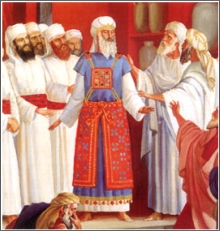
I was talking with a friend the other day about all the stuff the pastor wears. You know the items, robe, collar, stole. We got to talking some about how those things have come and gone, depending on the times, and the denominations. These days robes are meant to signify something or someone different. They are a throwback to the role of the priest in the Old Testament. Only it wasn’t so much the robes then, but the colors, and the different armor the priests put on, from that of a common warrior. The breastplate had semi-precious stones embedded, and the 12 tribes of Israel inscribed on onyx shoulder pads, and a giant helmet. This was a very strong departure from Moses and his predecessor priests who led by example, rather than ornamentation. Since that time the church has seen the ebb and flow of each of these types of ornamentation, that which meets the people as they are, and that which shows the display to draw attention. The cycle is ever-changing, and the rationale always fluctuating between the need to be seen as “human, like them” and “a special one from God”.

And so it is with life cycles. Some lives run longer than others, like that of the church (institutions seem to have lifespans of about 200-250 years), versus that of a human being (current average age in the US is about 76), or the fruit fly (in optimal conditions about 30 days). As we consider where in the stages of the lifecycle we find ourselves, we have the opportunity to remember why we decided to act as we did in gathering for this activity or that one, and for the mission of the church at the outset. In doing so we have a great opportunity to re-envision how we can help the next generation meet those same questions of “why” in their lives, knowing full well, that the what will change, as well as the rationale that will get them to the why.

You see, for all the cycles and rhythms of life, the why of the church never changes, to worship God, and show God’s love into the world today. In a world with growing diversity, and increasing differences between people, economically, educationally, spiritually, ethnically, and beyond, the lines are also becoming more blurred, and open to question. Ours then, as the church, and its people, continues to be a deep need to share the Amazing God we know with the world, in such a way that God is made clear.

Peace,

Labels: , , , , , , , ,

Wednesday, February 16, 2011

Witnessing

Have you ever been convicted?

You know that deep turning of your soul that reminds you of a particular action you did or should have done.

I had that experience just now. The doorbell rang, and it wasn't the very wonderful and gracious lady who has provided meals for my sick wife, child and myself for the past few days with another kind offering of great food. My daughter ran to the door and pulled back the curtain, and it was young men dressed in shirt and tie, holding pamphlets and Scripture books.

I opened the door wary and yet with enthusiastic greeting. I was immediately set-upon to shill the church these young men attend. I asked if they would then be coming to my church, as I am a pastor, too. This of course caught them offguard, shoved a few pamphlets and treated to silence and quick looks at one another as they formed the next step in their strategy.

Out came those most carefully applied words of traditional evangelism in the last 40 years, "If you were to die tonight, would be assured that you were going to Heaven."

It was at that moment that I lost my sense of decorum, laughed quite boisterously and said, "Really, that's your opening? You really need to work on that."

I did conclude with, "Yes, I am a pastor. Yes, I am assured I am going to Heaven. Thank you." Then I shut the door.

My wife, being the ever-faithful ecumenist, offered her apologetics and tried to remind me of what these young men were really trying to do. And I applaud her greatly for this, knowing full well, that if it had been her, I would have been attempting to redeem them at that moment as well.

She then offered this great line, "How scared of God do you have to be to go door to door trying to get others to be so scared of God that they would come to your church?"

And then it hit me. The moment of conviction fell upon my poor little head, and I think I know what I need to do in the next few weeks.

I had prayed for our neighborhood over the past year, and I have mentioned that I need to go visit with our neighbors. I haven't done it yet, and the time has come. God has whomped me over the head with this kind of reminder, that I have something else to offer, with an outstanding church.

I expect to spend time in the next few weeks going to our immediate back fence neighbors and saying hi, introducing myself, and asking what we can be doing to be better neighbors. I might get laughed at. I expect to get yelled at, because we have not done what some of our neighbors have "demanded" that we do. There are old wounds from the church, both ours and others.

At the end of it all, I want to remind folks that I am not there to convert them. The truth is God does that job. Mine is to help them find fellowship, and a place of sanctuary with our common space, the fence and community we share. This means we are present in those moments to help birth transforming love.

As for what I might do about the church that came visiting, my mind is still spinning.

Labels: , , , , , ,

Wednesday, December 29, 2010

Musings from my Wife

Still wrestling with a thought from my wife who in a Bible Study the other day was asked about why Atheists were such a hard breed to crack.

She shared the thought that the problem Atheists face is the same problem Biblical Literalists face: namely that concretes are the imperative. Where the atheist sees no concrete answers to the "God problem" the literalist must hang closely to the "facts" of scripture, and find concrete evidence therein.

I bring this up as the latest news shares the discovery in Israel of a 40,000 year old set of remains of early humans, thus refuting the previous hypothesis that Humans started in Africa. I suspect literalists will jump on this very aspect as further "proof" that the creation story is accurate.

And in the end the Atheists will bring to light the major flaw of such thought that if we follow the Scriptural account closely 40,000 years ago is far beyond the age of "Biblical Creation" generally regarded as about 6,000-8,000 BC.

Suffice it to say, our faith is one of wonder and mystery, and looking at the facts, and the doubts, and questioning, and learning about the most important aspect of it all, relationship with God and one another

Labels: , , ,

Tuesday, August 11, 2009

Lord, I apologize

With apologies to Larry the Cable Guy for the title of the blog, I offer deeper apologies to those with whom I ignored relationship to get "closer" to God.

True I need to get closer to God, but maybe I ought to work on some relationships with other people first, as part of that deep Commandment "Love the Lord your God with all your heart, soul, strength and mind; and love your neighbor as yourself"

Want to understand more: read Experimental Theology and this Blog about the bait and switch mentality of much Christianity, or more appropriately to my terminology - Churchianity

Labels:

Saturday, August 08, 2009

Because It Is All Too Real!

What does a Pastor do all week? The secret is out, and ministers everywhere are up in arms.


What? You thought I visited the sick, prayed with those who were hurting, read the Bible, studied the culture?

Labels:

Tuesday, August 04, 2009

Liturgy

Something I have been pondering on lately is a learning I had just a few days ago. It revolves around the term liturgy. We talk about having a "Liturgical Service" at St. Andrew UMC as our second service. The first is "A Service of Praise and Worship in a contemporary style". It was after I discovered these things that I heard the definition of liturgy. I had assumed it meant the words we follow in worship. And this person had dug a little deeper.


Liturgy (leitourgia) is a Greek composite word meaning originally a public duty, a service to the state undertaken by a citizen. Its elements are leitos (from leos = laos, people) meaning public, and ergo (obsolete in the present stem, used in future erxo, etc.), to do. From this we have leitourgos, "a man who performs a public duty", "a public servant", often used as equivalent to the Roman lictor; then leitourgeo, "to do such a duty", leitourgema, its performance, andleitourgia, the public duty itself.

We have then morphed it into the more common definition as found at Dictionary.die.net

Liturgy \Lit"ur*gy\, n.; pl. Liturgies. [F. liturgie, LL. liturgia, Gr. ? a public service, the public service of God, public worship; (assumed) ?, ?, belonging to the people, public (fr. ?, ?, the people) + the root of ? work. See Lay, a., and Work.] An established formula for public worship, or the entire ritual for public worship in a church which uses prescribed forms; a formulary for public prayer or devotion. In the Roman Catholic Church it includes all forms and services in any language, in any part of the world, for the celebration of Mass.
So what would it mean for the worship of the church to be returned to the people, as a public service to God?

Labels: ,

Friday, May 08, 2009

Perfect Pastor

I have to say I am reminded of this each time we come to appointment season.

Since it is time for church pastor turnover, and I know Ojai UMC is going to be receiving a new one...some thoughts

The Perfect Pastor

The results of a computerized survey indicate the perfect minister preaches exactly fifteen minutes. He condemns sins but never upsets anyone. He works from 8:00 AM until midnight and is also a janitor. He makes $50 a week, wears good clothes, buys good books, drives a good car, and gives about $50 weekly to the poor. He is 28 years old and has preached 30 years. He has a burning desire to work with teenagers and spends all of his time with senior citizens. The perfect minister smiles all the time with a straight face because he has a sense of humor that keeps him seriously dedicated to his work. He makes 15 calls daily on congregation families, shut-ins and the hospitalized, and is always in his office when needed.

If your minister does not measure up, simply send this letter to six other churches that are tired of their minister, too. Then bundle up your minister and send him to the church on the top of the list. In one week, you will receive 1,643 ministers and one of them will be perfect. Have faith in this procedure.

One chuch broke the chain and got its old minister back in less than three weeks....so don't break the chain.

Labels:

Wednesday, May 06, 2009

Retractions

So what does one do when faced with mounting evidence that the work done is not that factual...or helpful? The newspapers just print a retraction. I will go forward to say that my former post on the Hokey Pokey may not be all that accurate. I did try to have fun, and I shared what I had learned...albeit wrong. Guess it goes to show it helps to never stop learning...and may explain why the same sermon topic or title may never be the same again, even when faced with the same scripture or topic.

I would like to share with you Taylor Burton-Edwards' helpful thoughts...

David,

I offer these words to you directly. I hope you may receive them in a spirit of brotherly concern for you, for your ministry, and for our church and its relationships with other churches.

Are you aware that your blog post on this from last October (which I happened to find this morning) could be interpreted by Roman Catholics and many other Christians as deeply offensive?

Legend of the Hokey Pokey

You might want to consult the wikipedia article on this song. It notes (with solid citations) the origins of the interpretation you offer as intentionally anti-Catholic, and it notes cited references from several other scholars and from the grandchildren of the author of the song both refuting this interpretation and offering the ones they know from the time the song was written.

You can read it here: http://en.wikipedia.org/wiki/Hokey-Pokey

I'm not sure of your source, but whatever it was also did not understand how the Roman Mass worked-- then or now. My information here is not from wikipedia, but from many years of scholarly work on Christian ritual.

"Hoc est corpus enim" is nowhere near the beginning of the Latin mass. The priests would have been at the altar, facing it, long before they got to these words. It is part of the words of institution, which appear, as in our current UM ritual, closer to the middle of the Eucharistic prayer-- and actually, then (both when the song was written and in the pre-Vatican II liturgies) a bit closer to the end of it.

The first act of bowing at the Lord's Table is during the first part of the Sanctus-- which appears closer to the beginning of the Eucharistic Prayer, and well before the Words of Institution. Bowing after the consecration did also happen in some traditions (not all), but that bow would have been no more notable as the bow at the Sanctus. The bow at the Sanctus, by the way, may have been joined by all the people, not just the priest. So the order of these ritual actions appears a bit odd relative to the song.

To my knowledge there have never been any rubrics calling for the use of the left hand to bless anything. The right hand blesses the wine, as it does the bread, as it does the people. This is found in every rubric book, every liturgical text, and every example of church art including such acts of blessing (the earliest dating from the sixth century in Syria) that I know of.

The notion of "shaking the hand over the elements" would be considered blasphemous to Roman Catholics and other who follow the classic rubrics at the words of institution.  The instruction in the rubrics here was to make the sign of the cross over the bread and break it (again, pre-Vatican II-- in many post-Vat II liturgies, the fraction follows the epiclesis, which comes later, as in our ritual) and then over the wine, and then to touch each cup or flagon after the appropriate words. This is not an act of incoherent shaking-- but an act of clear signification of the importance of this moment-- Christ entering the bread and wine and blessing it.

I think I understand that you were trying to have some fun with this-- and to help make the actions of the communion ritual more memorable in a way. However, given these factors, your article may, for some,  be offering more offense than blessing.

Peace in Christ,

Taylor Burton-Edwards

Labels:

Friday, April 17, 2009

Dan Dick

Dan Dick has long been one of my favorite people at the General Board of Discipleship. This past year he was let go, and like so many let loose he began to blog in earnest, with all the things he had been doing for the church.

I have loved his approach to taking figures, turning them sideways to help us examine them more clearly. His blog has rapidly risen to one of my top 10 favorite blogs to read.

The other day he posted on the church, and why the faithful are leaving. I was touched by this and recognize in this post, the needs that the church has to meet in the community to stay vibrant and active beyond the life of the reputation.

Go take a look and check it out.

Labels:

Thursday, March 12, 2009

Churchianity "Why?" Part II

If the choir robes question was not enough on robes, here is one for the pastors:

Why do pastors wear robes? (and what are all the things they wear)

-As a sign of Office. This is a holdover from the days when the Levites got dressed up all nice a pretty-like to preside over the Temple sacrifices.
http://davidjlarsen.files.wordpress.com/2008/06/worship-high-priest.jpg

-This has persisted as it was a sign of education as well, since the clergy were often the most educated folks in the crowd, and they needed to display that.

-Simply a version of pomp and circumstance. People loved the idea of the clergy being dressed up for services.


These days the debate rages on about whether the Robe is Good or Bad. I suppose the same arguments could be made for Good or Bad regarding the use of clergy collars too.

Labels:

Saturday, March 07, 2009

Churchianity "Why"? Part 1

Question: Why do choirs wear robes?

Answer(s):

I will first borrow from the faithful who have sung in choirs as to their responses.
Choirs wear robes to represent that we are a unified group.
To keep from being a distraction for the worshipers hearing the message of the anthem 
To keep people with hypothyroidism like me warm.
'cause their so purty (sic)

Then some of the understandings I have gained.
-Uniformity: 
It provides a common clothing for the group, and makes it as though the group is one, as the choir should sound like a single unit.

-To provide "appropriate" dress for all.
Not everyone has nice clothes for church. In some cases it is to keep the choir from "competing" with their clothing. In other cases it is to keep everyone with the same "amount" of clothing...wouldn't want the men wearing the boxers and short shorts, or the women in the Jennifer Lopez green dresses now would we?

-To stand out from the congregation.
The choir wants to make a statement that they are different from the rest of the congregation, and have a different role to play in the service. A similar dress code makes that apparent.

And some actual historical answers.

Labels: